
Pi Agent Desktop is a local-first, open-source workstation that transforms the Pi Coding Agent into a standalone desktop GUI. Built with Electron and React, it executes developer workflows, manages sessions, and orchestrates browser automation without requiring background web servers.
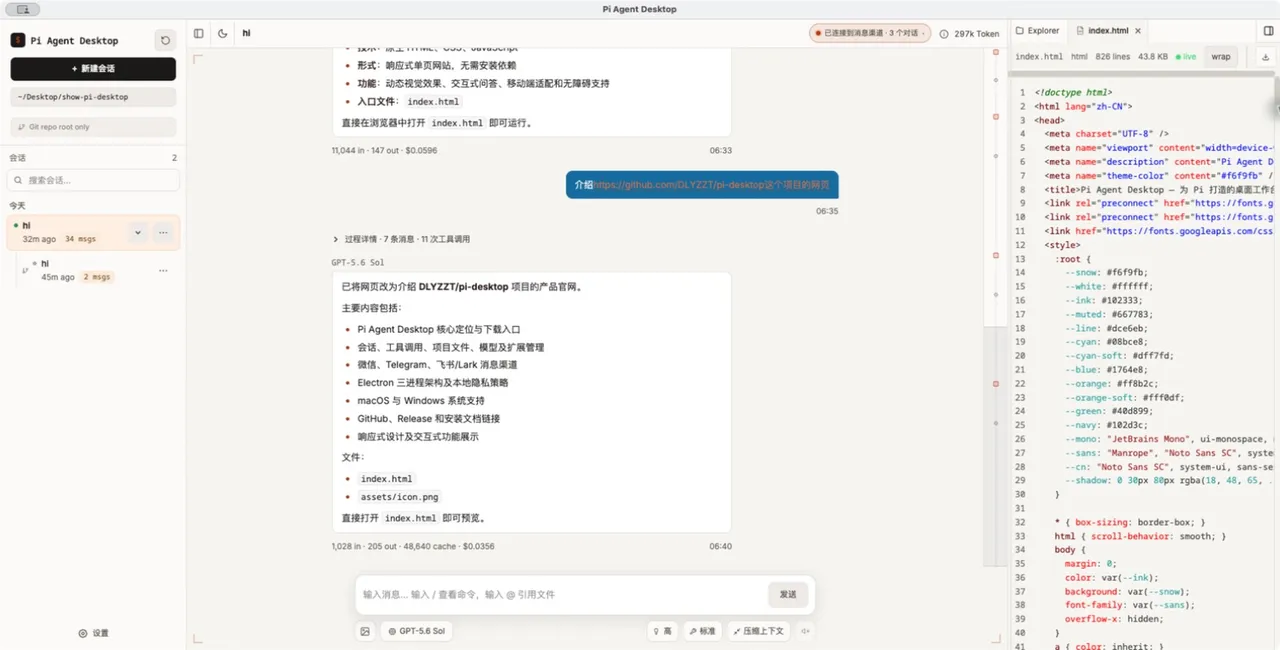
Technical Overview of Pi Desktop
Pi Desktop isolates tasks via a three-process Electron architecture that keeps high-privilege execution in an independent utility process while running the sandboxed React interface. It operates with zero internal HTTP or TCP servers for inter-process communication, securing local data inside ~/.pi/agent/. Installable packages are available as standard system installers alongside standalone AppImage formats across supported platforms.
Core Features of Pi Desktop
- Zero internal servers secure local-first execution by keeping all IPC interactions within sandboxed Electron MessagePorts rather than exposed network ports.
- Embedded Chromium environment runs inside an isolated WebContentsView, granting agents permission-gated page snapshots, form interaction, and CDP inspection.
- Managed background processes handle Vite, dev servers, and mock APIs via native POSIX groups on Linux/macOS and Rust-validated Job Objects on Windows.
- Unified agent runtime ships with Pi Coding Agent 0.84.0 and bundled ripgrep/fd binaries, ensuring essential searching and coding functions run completely offline.
- Multi-channel chat bridging enables remote agent control through outbound-only connections to Telegram, Lark, and WeChat without opening inbound webhooks.
System Compatibility & Updates
Pi Desktop runs on macOS 12 Monterey or later (Apple Silicon arm64 and Intel x64), 64-bit Windows 10/11 (x64 only; 32-bit and ARM64 are unsupported), and 64-bit Linux distributions (glibc x64 AppImage). The v0.2.0 release introduces managed background process trees using Rust helpers and Job Objects for Windows 11 alongside integrated browser controls.
Why Choose Pi Desktop?
Pi Desktop gives developers an offline-capable, transparent AI programming environment that respects data ownership by storing configurations strictly on local disk. Its hardened permission model and process supervision prevent autonomous coding tools from executing destructive background tasks unchecked.